
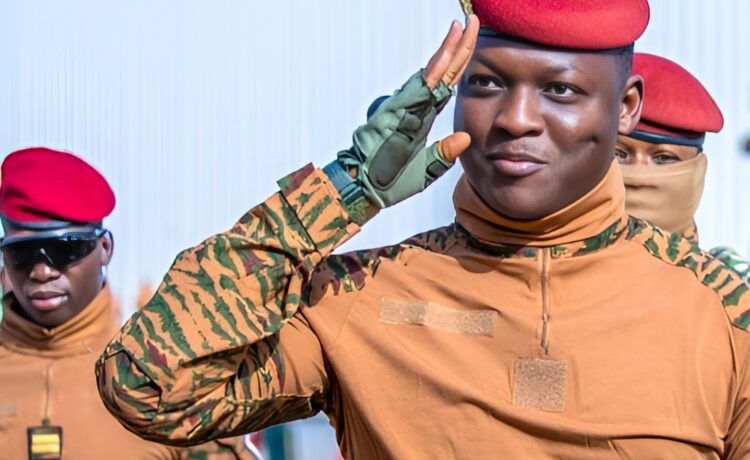
BURKINA FASO: A Nation at a Crossroads
Burkina Faso has long been entangled in the fight against violent extremism. For years, terrorist groups linked to al-Qaeda and ISIS have destabilized the country, leading to the deaths and displacement of thousands. Frustrated by what many saw as ineffective civilian governance, parts of the military stepped in — not once, but twice — in rapid succession in 2022. That second intervention brought Captain Ibrahim Traoré, then just 34 years old, to power. His mission? As he states it: to restore security, assert national sovereignty, and rid the country of foreign interference
Who Is Ibrahim Traoré?
Traoré’s background as a military officer and geologist has fed into his image as both grounded and tactical. Often seen in military fatigues or among civilians, he projects an anti-elitist, Pan-Africanist vision — speaking openly about Burkina Faso’s right to chart its own course without depending on foreign agendas.
He has called for:
- A departure from the neocolonial status quo
- Economic and security self-reliance
- Unity among African nations, particularly in the Sahel
To many, especially youth, he is seen as a modern-day continuation of Thomas Sankara’s legacy — the revolutionary former president who sought to reshape Burkina Faso in the 1980s with radical self-sufficiency and anti-imperialism.
The Rising Discourse: Freedom, But On Whose Terms?
Across social media and grassroots movements, Traoré has become a symbol of defiance and dignity — but his rise has also sparked necessary debate:
- Can military rule deliver democratic outcomes?
- How do you balance national sovereignty with international cooperation?
- Where does freedom lie when civil liberties are curtailed in the name of security?
These are the questions scholars, citizens, and observers continue to ask. But one thing is clear: a hunger for change is alive in Burkina Faso — and perhaps, across Africa too.
Beyond the Headlines: A Generation Watching Closely
For many young Africans, Ibrahim Traoré represents something different — not perfection, but possibility. A leader not molded in the typical political machinery, but someone who dares to ask hard questions about:
- Ownership of natural resources
- The future of African education and defense
- Pan-African cooperation beyond symbolic rhetoric
Whether one agrees with his approach or not, his impact on the continent’s political discourse is undeniable.
A Continental Reflection: What Does Freedom Look Like in 2025?
As we mark Africa Freedom Day, we are invited to rethink what freedom truly means — not just independence from colonial rule, but:
- Economic justice
- Educational transformation
- Cultural self-affirmation
- And ultimately, the ability to define our future on our own terms
Burkina Faso’s current reality is a microcosm of the continent’s enduring struggle to reclaim agency in a globalized world. It reminds us that freedom is not a destination — it is a journey, one that must be continuously shaped by bold ideas, introspection, and collective courage.
Conclusion: From Watching to Engaging
The story of Burkina Faso under Traoré is still unfolding. But for the rest of Africa — particularly its rising generation — it’s a story worth watching, worth debating, and perhaps most importantly, worth learning from. It reminds us that African freedom is not a historical achievement — it’s an ongoing mission.
